5 Dragon Drawing Styles You Can Try: From Easy to Realistic
Since millennia, dragons have fascinated people across cultures. Dragons are a fascinating subject to artists around the world. From ancient myths about fire-breathing dragons to modern fantasy epics. Their powerful presence and varied forms have fascinated them for millennia. dragon drawings are a great way to explore your creativity, whether you’re just starting out as an artist or a professional illustrator who wants to broaden their horizons. The beauty of dragon drawing is the variety in which these creatures can appear. Each one offers a different challenge and rewarding experience.
This comprehensive guide will explore five different dragon-drawing styles that cater to various design and skill preferences. From the most simple, beginner-friendly techniques to the complex world of hyper-realistic art, we’ll explore them all. We’ll examine the defining features of each style as well as its ideal audience, recommended drawing tools, and other essential tips. Discover new techniques and find the best style for your skill level. Then unleash your imagination to create your own dragons!

1. Easy Dragon Drawing for Beginners
It doesn’t need to be difficult for you to begin your Dragon Drawing journey. This “easy” style was created for beginners, and is a gentle introduction of the basic shapes and forms which make up these majestic beings. This style is based on simple shapes, soft curvy lines, and basic outline. It’s incredibly accessible for anyone, from young aspiring artist to casual sketchers or absolute beginners.
Style description: Imagine the dragon reduced to its simplest elements. The basic shapes are ovals and curved lines, with simple teardrop or triangle shaped wings. Lines are usually clean and uncluttered. They emphasize clarity over complexity. The overall impression can be charming and friendly. This allows the artist to relax and enjoy the process.
Audience: This is a great style for children who will quickly understand the concepts and get immediate satisfaction from creating a dragon. This is also a great way for adults to gain confidence, as it’s a simple and low-pressure method. This simplified method is great for casual artists who are looking to create a quick and fun doodle.
Tools that you can use: Easy Dragon Drawing is a simple drawing with minimal tools. You only need a pen and paper. Sketching is best done with a simple HB or a 2B pencil, on any drawing paper. If you prefer digital art, then a tablet and a drawing app like Autodesk Sketchbook or Krita (or even simpler mobile apps) will work just as well. Focus is on shape and not intricate rendering.
Basic Steps: This process is simple and builds on itself.
Outline basic shapes. Begin with a larger oval for the body, and a smaller circle or oval for the head. Connect them by a curved neck line.
Add body and limbs. Create the main body shape by defining the oval around which you placed the initial body. Then add simple legs and toes.
Draw the wings. Imagine two large, round shapes that extend from the dragon’s rear. Keep it simple. Perhaps with a few finger-like projections.
Create the face. Add a smiley mouth with a simple curved line and two dots. As simple extensions, you could add tiny nostrils and horns.
Revise and erase: Lighten and erase your initial sketch lines. Remove any unnecessary lines.
You’ll be surprised at how quickly a dragon can be created by following these simple steps. Consider looking at beginner tutorials on the internet. They often break these steps down even further and make it very accessible.
2. Cartoon Dragon Drawing (Fun and Expressive)

After you have mastered the basics it is time to add some personality to your work using the cartoon drawing technique. This dynamic and vibrant approach allows for endless creativity. It transforms mythical creatures into adorable, funny, or comically fierce characters.
Description Cartoon Dragons are characterized by their exaggerated facial features, expressive eyes and a whimsical, playful demeanor. Character and emotion are more important than anatomy in cartoon dragons. You’ll often see disproportionate body parts, such as tiny bodies with large heads, oversized shoes, or ridiculously-long tails. These all contribute to their unique appeal. They are usually streamlined and use bold colors and lines to express personality.
Commonly found in: This is a style that’s used in books for children where friendly dragons lead young readers on adventures. These characters are common in Comics and Animation. They deliver visual gags, dramatic expressions and even comedic moments. Imagine characters such as Toothless (especially during his playful moments), Mushu, from Mulan or the classic Puff the Magic Dragon.
How do you stylize features? Exaggeration is the key to creating a great cartoon:
A big head and a small body: This creates a childlike, endearing quality.
Expressional eyes: Even in cartoons, the eyes are the windows of the dragon’s heart. Make the eyes large with prominent pupils and experiment with different brow angles to express emotions such as joy, surprise or anger.
Funky expressions: Try wide smiles, furrowed eyebrows, mouths open with silly tongues or even puffy cheeks.
Wings and simplified limbs: Although still recognizable and functional, wings may be smaller, more decorative, or even noodle like.
Customized horns/spikes Give unique shapes to them – curly or spiky, bent or multiple small ones.
Bonus tip – How to use color to express personality in cartoons Dragon drawing. Bright colors can convey a cheerful personality, while darker or muted tones suggest mischief or a grumpy one. Consider how color can affect their mood. A bright, playful green dragon or a dark, grumpy purple one? Let the backstory of your dragon influence its expression and design. Is it a hoarder of shiny things? Does it fear butterflies? These details can inform your artistic decisions.
3. Anime Dragon Drawing – Fantasy meets Elegance
anime drawing is a style that offers an exciting challenge for artists who are drawn to elegant designs, intricate detail, and a combination of power and grace. This style is characterized by a unique aesthetic which combines traditional Japanese art sensibilities with dynamic storytelling.
Description Anime Dragons are often characterized by stylized anatomies that combine realistic influences and artistic liberties. The dragons can be anything from elegant serpentine creatures to fierce, powerful creatures with a distinctive flair. Lines are usually clean and precise with an emphasis on movement and flow. Exaggeration in anime is not meant to be humorous, but rather to emphasize drama, speed or beauty.
Seen In: This is a style that’s a cornerstone in Japanese anime and manga. Dragons are often depicted as powerful antagonists, wise allies, or ancient guardians. It’s also a major influence on countless fantasy drawings, and video games which are inspired by East Asian aesthetics.
Key elements:
Sleek Body: Many dragons in anime, especially those that are inspired by Eastern dragons have long, serpentine body shapes, which convey grace and speed. Western-styled anime dragons have a more athletic, refined physique than their realistic counterparts.
Detailed Eyes: Like cartoon dragons, anime eyes often have more depth and intensity. They come alive with large, well-defined eyes, reflections and subtle shading.
Common decorative features: These include spines, whiskers and flowing manes. They also have intricate scale patterns and ornate horns. These features add to the elegance and mystique of dragons.
Dynamic poses Animation thrives on emotion and action, so dragons often appear in mid-flight or coiled up in a powerful position, or gliding gracefully.
Drawing Tips: Use line weight to create drama and flow. This technique is used in anime and manga. By varying the line weight, you can add depth and emphasize form. Thinner lines are best for inner details and highlights, while thicker lines are better for shadows and outlines. To capture the smoothness of this style, practice creating confident, smooth lines. Think about the way the body flows and how the parts are connected.
As a reference, suggest a few well-known anime dragons:
Haku, the human/dragon hybrid from Spirited away. A beautiful example of a serpentine Eastern dragon.
Shenron, from Dragon Ball : A powerful Eastern dragon that grants wishes. It has a muscular, long body with an imposing appearance.
Acnologia From Fairy Tail A dark and powerful dragon with a Western influence that shows the darker side of anime design.
These examples will inspire you to create your own dragon anime.
4. Realistic Dragon Drawing
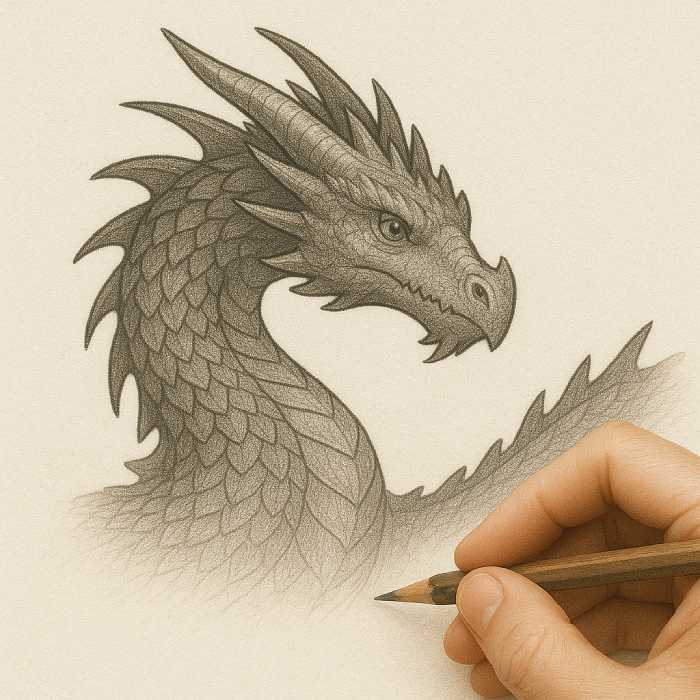
realistic drawing will challenge artists who want to develop their skills in creating fantasy creatures. This style is meant to portray dragons in a way that they would appear in the real world. It combines fantastical elements and anatomical plausible.
Description This is a style that is all about realistic anatomy, high detail and believable textures. The animal kingdom is a major inspiration for artists, especially reptiles like lizards, crocodiles and snakes for their scale patterns, skin texture and muscular structure. Bats and birds are also used for wing designs and movement. It is important to create a mythical creature that looks and feels real, even though it’s a myth. You will see subtle changes in skin texture and scale patterns. There will also be a clear understanding of light and shade.
Perfect for: This is a style that’s perfect for intermediate and advanced artists with a good grasp of drawing fundamentals like anatomy, perspective light, shadow, etc. This style requires patience, sharp observation skills, as well as a willingness and ability to explore complex rendering techniques.
Tips for structure: A realistic dragon is built from the inside:
Skeletal Base: Sketch a simplified animal skeleton, just as you would when drawing an actual animal. The dragon’s pose, proportions, and balance are established. Consider the spine, ribs, and limb bones.
Muscle shapes. Overlay the musculature on your skeletal frame. To understand the muscles’ attachments and bulges, study animal anatomy. This will give your Dragon a feeling of power and realistic movements.
Wingspan: Analyze the structure of bat or bird wings. Understanding the structure of the finger bones that support the membrane, and the way the membrane stretches and folds is important. Aerodynamics: How would these wings lift a creature of this size?
Form and shading: This step is essential for realism. Use shading techniques to create depth and define forms. Understanding how the light hits the body of the dragon and creates shadows will help you to emphasize the three-dimensionality and scales.
Tools The tools you choose can have a significant impact on the level of detail that you can achieve.
Graphite Pencils: A variety of graphite pens (from hard B pencils to dark shading to soft H pencils to light lines) are essential to capture a range of tones and textures.
Digital Tablet: A graphics table (like a Wacom tablet or iPad Pro with Apple Pencil), and software (Photoshop Procreate, Clip Studio Paint, etc.) give you unparalleled control over layering, blending and creating complex textures using custom brushes.
Charcoal : Charcoal is excellent for dramatic contrasts and rich blacks. It’s especially good for realistic dragon drawings.
Colored pencils/Pastels/Paints: For adding realistic color, these mediums allow for layering and blending to achieve complex hues and a sense of life.
Remember that realistic drawing a dragon doesn’t mean perfect photo reproduction, but rather creating an illusion of reality.
5. Fantasy/Hybrid Styles (Mixing Styles Creatively)
Dragon drawing offers the opportunity to combine different styles and create something unique. Here is where you can start to find your own artistic voice.
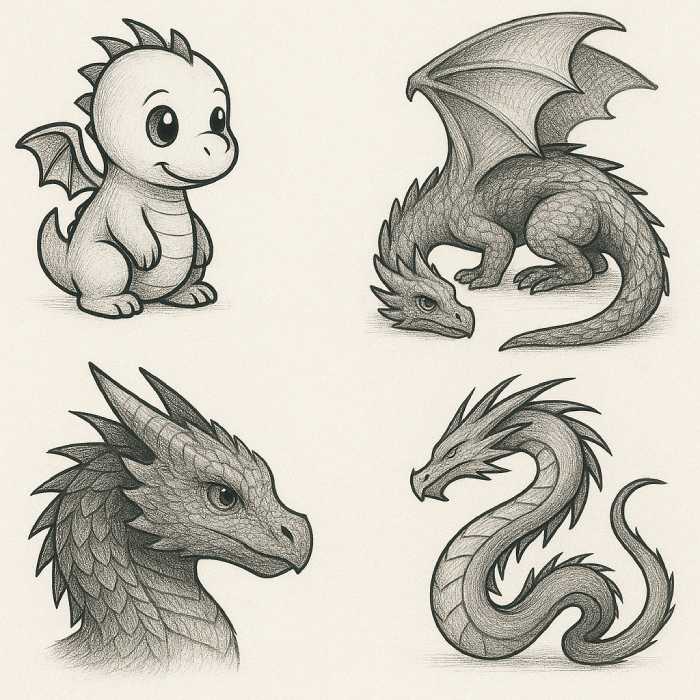
Combining different styles is optional but useful. Imagine the expressive eye of a cartoon with the sleek body an anime dragon. Perhaps a realistic wing with textured surface attached to a stylized, simplified body. Here, there are no rules. Only opportunities for fusion. This allows you to take the best parts of each style, and combine them into one cohesive design.
Encourage experimentation. Do not be afraid to use seemingly strange combinations. What would a realistic-scaled easy-style dragon look? What about an anime dragon that has the exaggerated horns from a cartoon? Draw freely and without judgement. You will find that some combinations work better than others. However, every experiment you do teaches something new about composition, form, and line. Many artists use this iterative approach to develop their signature style.
Give a tip for developing your unique dragon style. It’s not something you can force, but it will develop naturally as a result of your influences, preferences and constant practice.
Find out what you like: Take a look at the dragons that you enjoy in different media. What are the elements that you find most appealing? What appeals to you? Is it their expression, their eye color, the scale texture, the shape of their wings or the overall silhouette of the animal?
Borrow, but adapt: Do not just copy. Understand the reasons why an element works in a different style and then adapt it for your vision.
Keep experimenting: Try different combinations. Keep a sketchbook for these experiments.
Refine, then repeat: You’ll notice that you tend to draw the same motifs and techniques over and over again. Focus on those. These choices, if made consistently over time, will eventually form the basis of your own dragon drawing unique style.
Discover your unique dragon through creative exploration.
Last Tips on Practicing Dragon Arts
No matter what your style is or how good you are at drawing, practice consistently will help you improve. Drawing dragons takes time and dedication.
Start by using references. Do not feel compelled to create a perfect dragon every time. Use references extensively! Use images of real reptiles to see the scale texture and muscular structure. Look at the anatomy and movements of birds and bats. Analyze the dragon designs of other artists that you admire in order to better understand their choices regarding form, line and shading. Your artistic vocabulary will grow as you learn more about visuals. Five minutes a day of concentrated sketching can make a big difference in a month.
Style challenges: one dragon, five styles It is a great exercise to improve your artistic understanding and versatility. Redraw a simple dragon in each of the styles that we have discussed. You will be surprised at how the same concept can appear different when filtered through various artistic lenses. It also helps you to better understand the defining features of each style.
Share your work with a larger community. This can help you grow. You can get great constructive criticism on platforms like Instagram, DeviantArt and Reddit, especially subreddits such as r/Art and r/Drawing. Open yourself up to criticism. It’s an opportunity for you to improve. To stay motivated, join online drawing groups or art challenges. Don’t forget to give feedback to other people – this will often help you to understand yourself better.
The conclusion of the article is:
The five styles we’ve explored are: Easy Dragon Drawing (for beginners), Cartoon Dragon Drawing (for exaggerated fun), Anime Dragon Drawing (for elegant dynamism), and Realistic Dragon Drawing with its intricate details. We also touch on the endless possibilities of Hybrid Styles. Each method offers a different way to bring these mythical beings to life, whether on screen or paper.
There’s a drawing style for dragons that you can master, no matter what your artistic goals or current level of skill are. Do not be afraid to experiment and try different styles. Discover which ones resonate with your artistic voice and spark your creativity. Dragon art is a versatile medium that offers endless possibilities. There’s always a new technique to try, a texture to discover, or an expression to capture.
It’s time to unleash your inner artist! Let your imagination fly! You are invited to share your incredible dragon art with the rest of the world. If you want to go even further, you can explore a detailed guide about dragon anatomy. This will help you improve your skills and give your fantasy beasts a more realistic look. Enjoy drawing!